
IRD Department Organizes National Workshop on Israel-Palestine Conflict: A Call for Peace
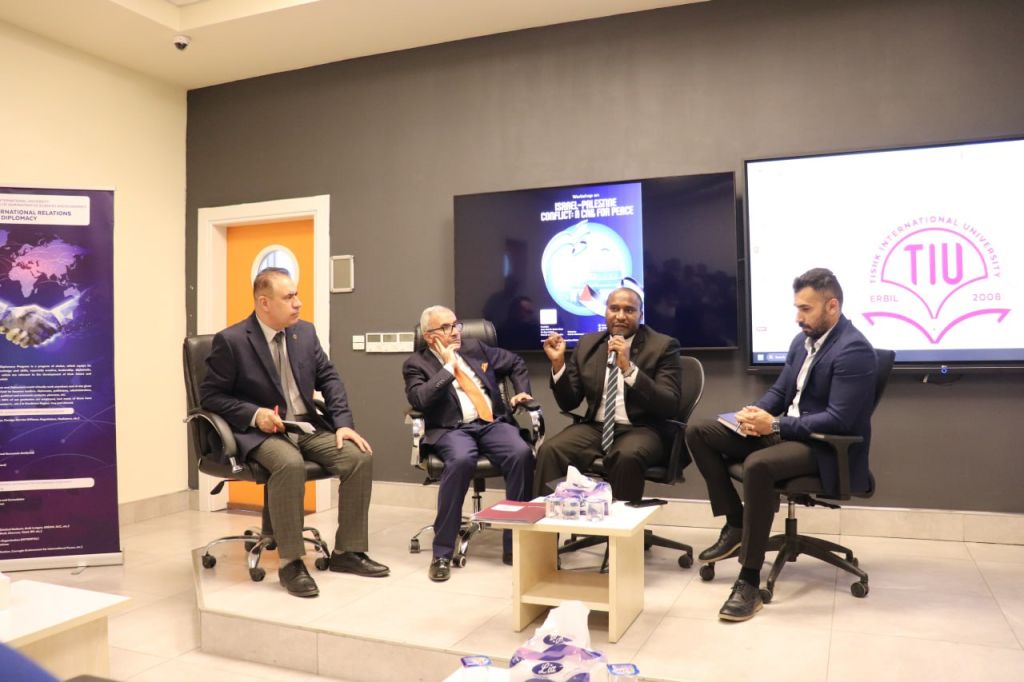
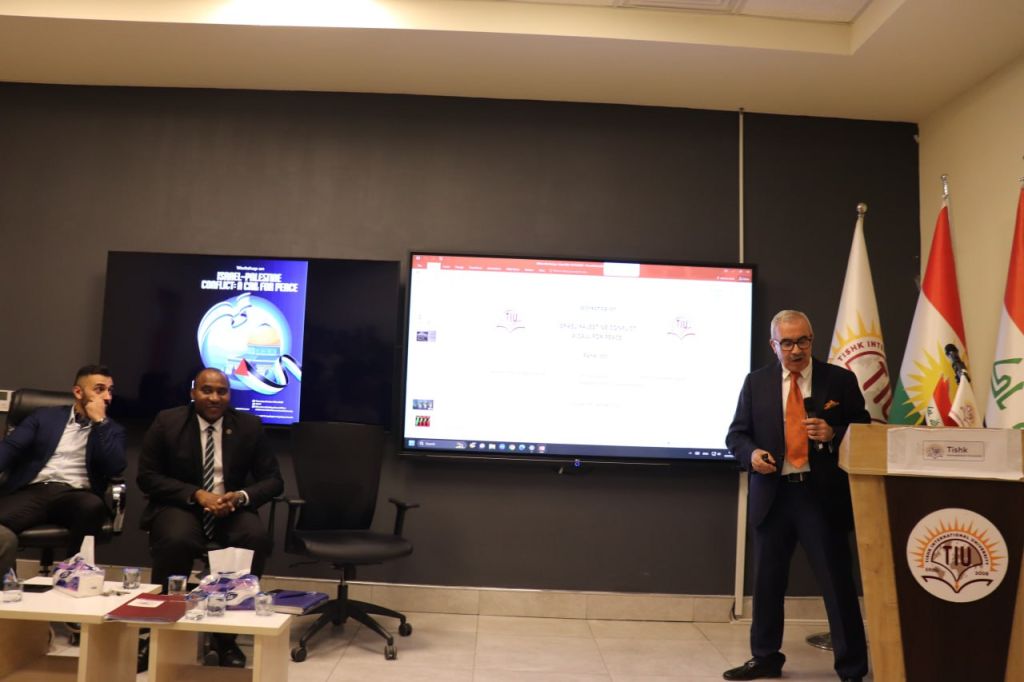
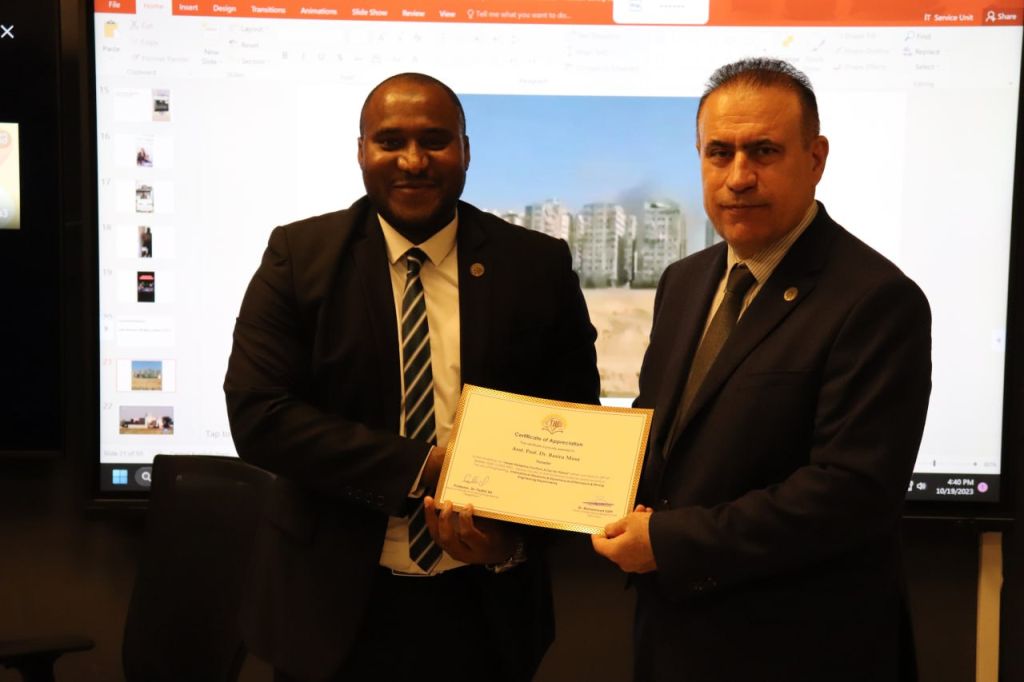
In collaboration with the Petroleum & Mining Engineering Department, Faculty of Engineering at Tishk International University (TIU), the International Relations and Diplomacy organized a National Workshop on “Israel-Palestine Conflict: A Call for Peace“, held on October 19th, 2023. The workshop began with an opening remark by the moderator, Dr. Mohammad Salih Mustafa, who explained the objective and importance of the workshop and introduced the distinguished speakers/panelists: Asst. Prof. Dr. Basiru Musa, Mr. Dana Sajadi and Prof. Dr. Hamed M. Jassim.
The first distinguished panelist, Asst. Prof. Dr. Basiru Musa started by tracing the historical trajectory of the Israeli-Palestinian conflict, which has thus far defied global solution for about 75 years to the 1917 Balfour Declaration and United Nations Resolution 181 (II) of 29th November, 1947 (Partition Plan), which paved the way for the creation of the Jewish state of Israel on 14th May, 1948 and the Arab/Palestinian state from the former British mandate of Palestine on the basis of two independent states. Following opposition to Resolution 181 (II) by Arab states, the first Arab-Israeli war erupted on 15th May, 1948 to 10th March, 1949. The 1967 six-day war resulted in further territorial changes, as Israel captured and occupied the Golan Heights from Syria, the West Bank (including East Jerusalem) from Jordan, and the Gaza Strip and Sinai Peninsula from Egypt, which had been under their control from 1949 after the first 1948 Arab-Israel war.
Asst. Prof. Dr. Musa further explained that the Gaza Strip had been under Israeli occupation from 1967-2005, even though it is worth noting that under the 1995 Oslo II Accord, the Palestinian National Authority was created to provide a Palestinian interim self-government in the West Bank and the interior of the Gaza Strip. He concluded by stating that the October 7th Hamas attack on Israel might be as a result of the Israeli occupation of the Gaza Strip and the desecration of the Al-Aqsa mosque.
The second distinguished panelist, Mr. Dana Sajadi shed light on the October 7th Hamas attack, which resulted in the ongoing war between Israel and Palestine (Hamas), and its geopolitical and global implications for peace, stability and development of the Middle East and the world as a whole. He also shared the view of the first panelist, in terms of the root causes of the conflict, which to a large extent border on the occupation. Mr. Sajadi further explained how the changing dynamics and power configuration of international politics have limited the chances of finding an immediate solution to the ongoing war, as seen in the rejection or veto of two United Nations Security Council Resolutions, put forward by Russia and Brazil by the United States of America. The Resolutions would have provided for a humanitarian pause and a possible cessation of hostilities.
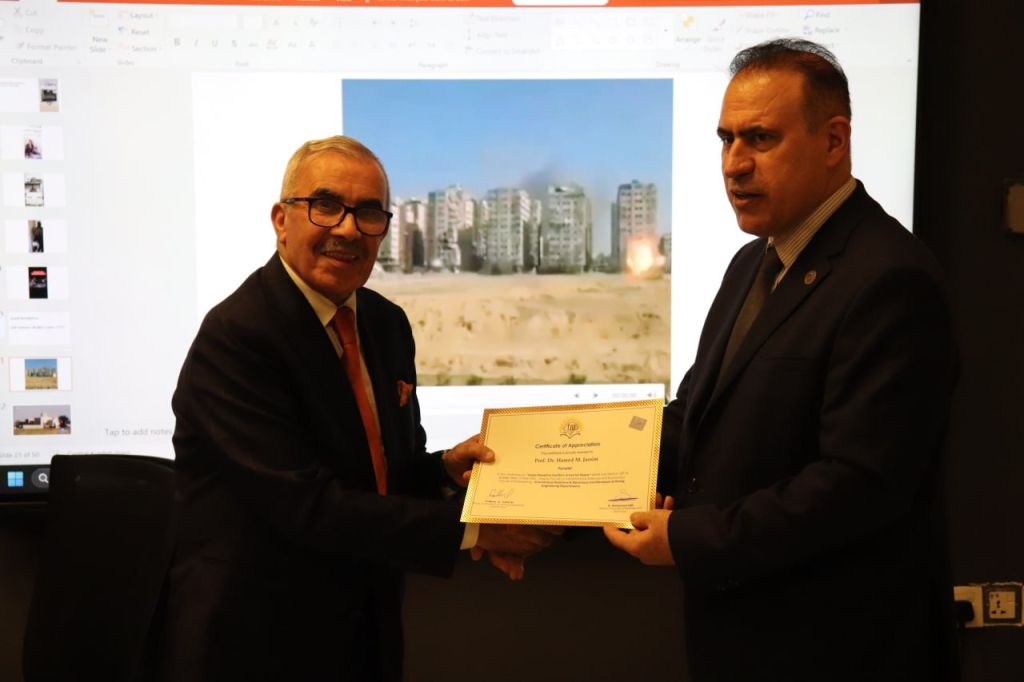
The third distinguished panelist, Prof. Dr. Hamed M. Jassim took the participants through a presentation of empirical, graphical data on the Israeli-Palestinian conflict, and the factors that have been undermining all the peace initiatives, agreements and UN Security Council Resolutions, aimed at finding a lasting solution to the perennial conflict and addressing the Palestinian Question of establishing an independent Arab State in Palestine.
The following recommendations were given by the distinguished panelists:
- Implementation of the two-state solution, as given in the 1947 UN Resolution 181 (II) or the Partition Plan.
- Ensuring an immediate ceasefire.
- Guaranteeing a humanitarian corridor for the uninterrupted passage of humanitarian aid.
- Respect for international humanitarian law.
- Stoppage of third-party interference, especially by the superpowers.
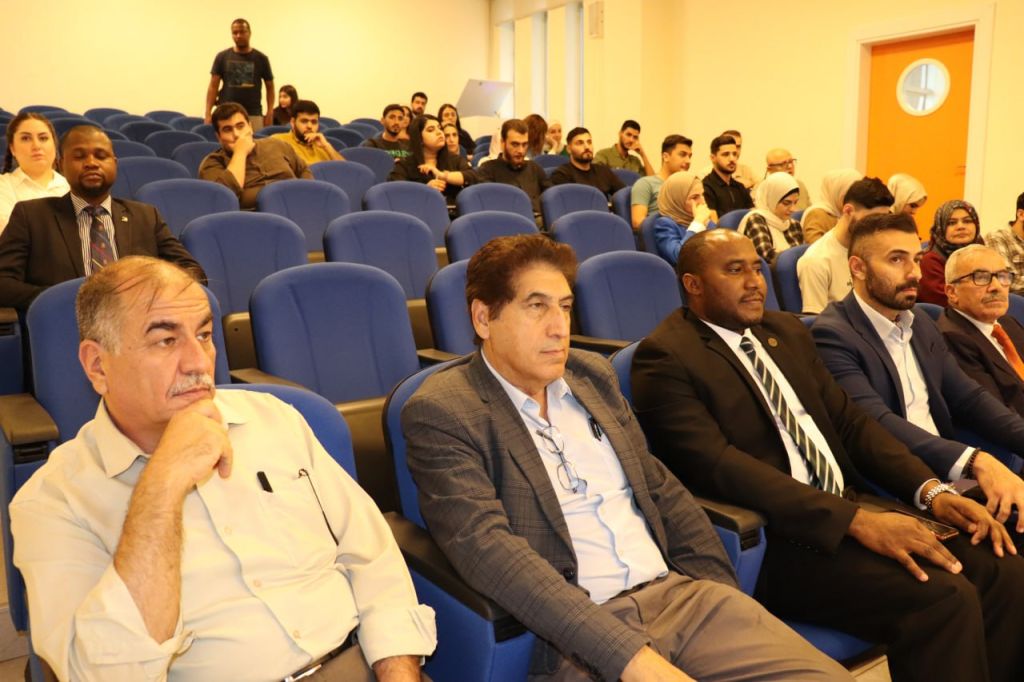
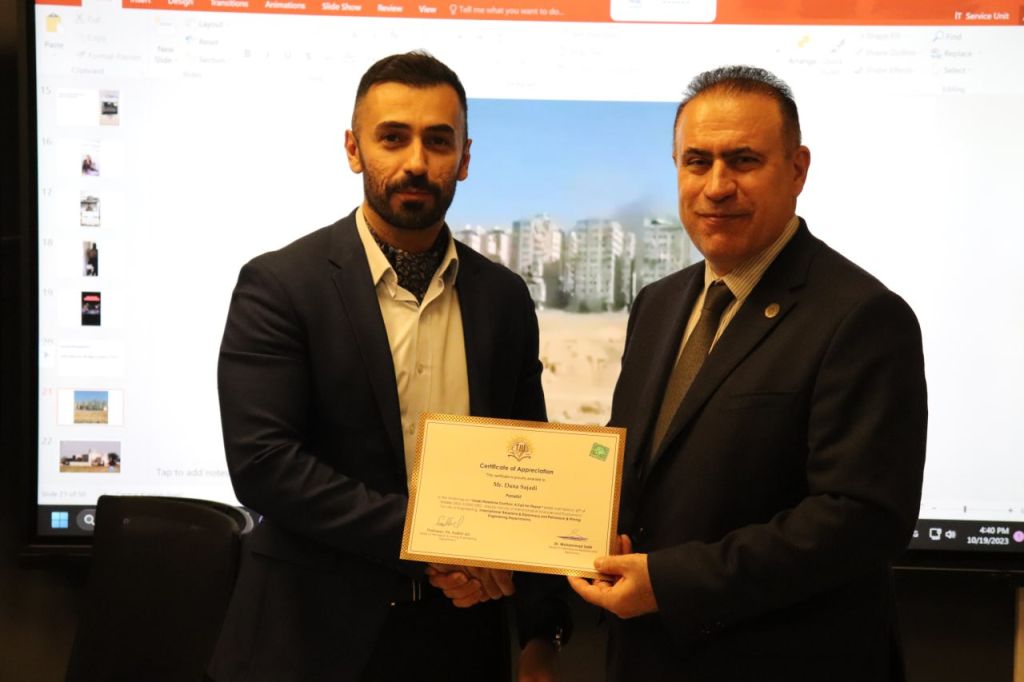
The Q & A session followed, where the panelists answered all the questions that were asked by enthusiastic participants, including TIU academics, students and international participants. Finally, certificates of appreciation were given to the panelists by the Head of IRD Department, Dr. Mohammad Salih Mustafa.