
IRD Department Organizes National Workshop on Education in the Courtyard of Politics
On March 9th, 2023, the International Relations and Diplomacy Department, Faculty of Administrative Sciences and Economics at Tishk International University, organized a National Workshop on Education in the Courtyard of Politics. The workshop commenced with a welcome address by the moderator, Mr. Bayad Sarwar, where he stated the topic of the workshop and introduced the two distinguished speakers, Asst. Prof. Dr. Basiru Musa from the IRD Department and Dr. Abdurrahman Ahmad from the Department of ELT, Faculty of Education, Tishk International University.
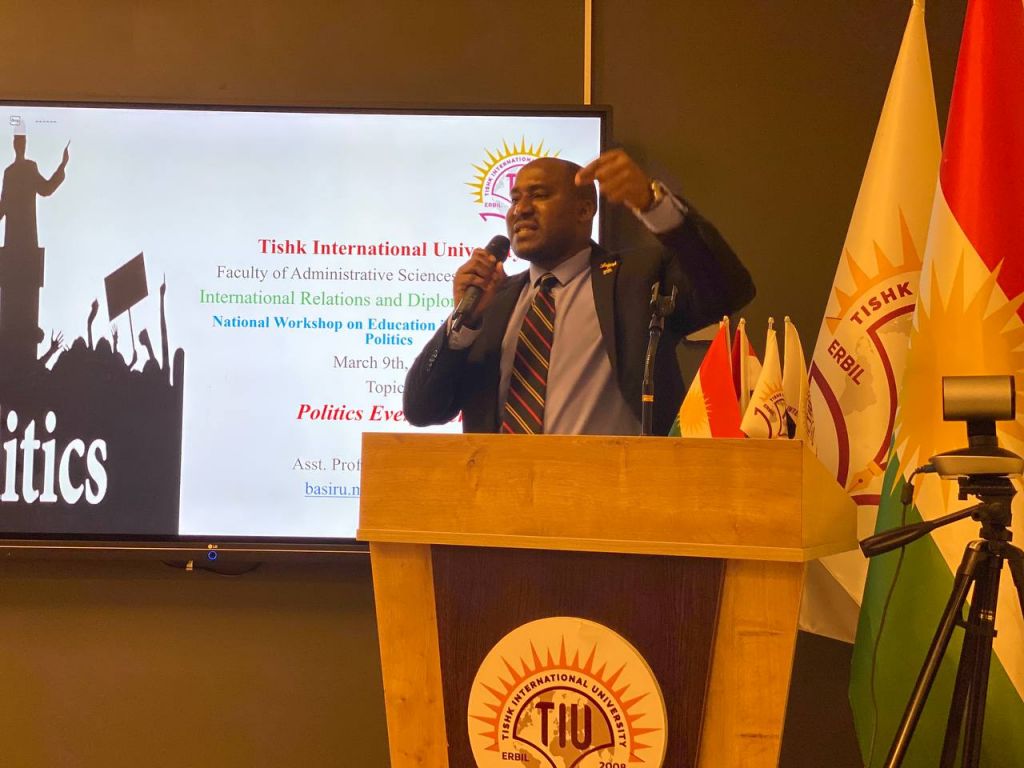
The first distinguished speaker, Asst. Prof. Dr. Basiru Musa presented on Politics Everywhere, where he traced the meaning of politics to the great Greek political philosopher Aristotle (384-322 BC), regarded as the Father of Politics and Political Science. Aristotle began his famous work on politics with the observation that “man is by nature a political animal.” By this, he means that the essence of social existence is politics and that two or more individuals interacting with each other or one another are invariably involved in a political relationship. Individuals are engaged in politics as they try to define their positions in society, struggle for scarce resources, and try to persuade others or get them convinced to accept their viewpoints. Aristotle then concluded that the only way to maximize one’s capabilities and attain the highest form of social life is through political interaction with others in an institutionalized setting, a setting designed to resolve social conflicts and set collective goals – that is, the State.
Furthermore, politics is seen as the process of making and taking decisions, as human beings take decisions for their needs and achieve set goals. Politics is about making and taking decisions binding upon a group of people, hence putting an end to conflict. Politics is, therefore, all about conflict and conflict resolution. In its classical form, Politics is an “art,” meaning the art of government represented by the exercise of power or control within a given society through the making and enforcement of collective decisions. It refers to the authoritative allocation of values in society. Aristotle describes politics as a “master science” because it is all around us and it influences all aspects of our human life. For instance, what we can do, what we can say, where we can live, and even what we can eat. Therefore, there is no way we can escape politics; however, we can discover more effective ways to use it and participate in it by studying Political Science – the systematic study of politics (Magstadt, 2009). Similarly, politics performs the critical functions of administration, distribution, redistribution, order and justice to promote the common good.
Asst. Prof. Dr. Basiru Musa also stated that given the functions and impact of politics on our lives, the argument that it is a dirty game could be debunked. However, it may seem a dirty game because the good or even the best and most patriotic citizens have refused to participate actively or even passively. He identified Normativism and Positivism as the two major approaches to studying politics. He explained David Easton’s Input-Output Model and how it can be best applied to a given political system.
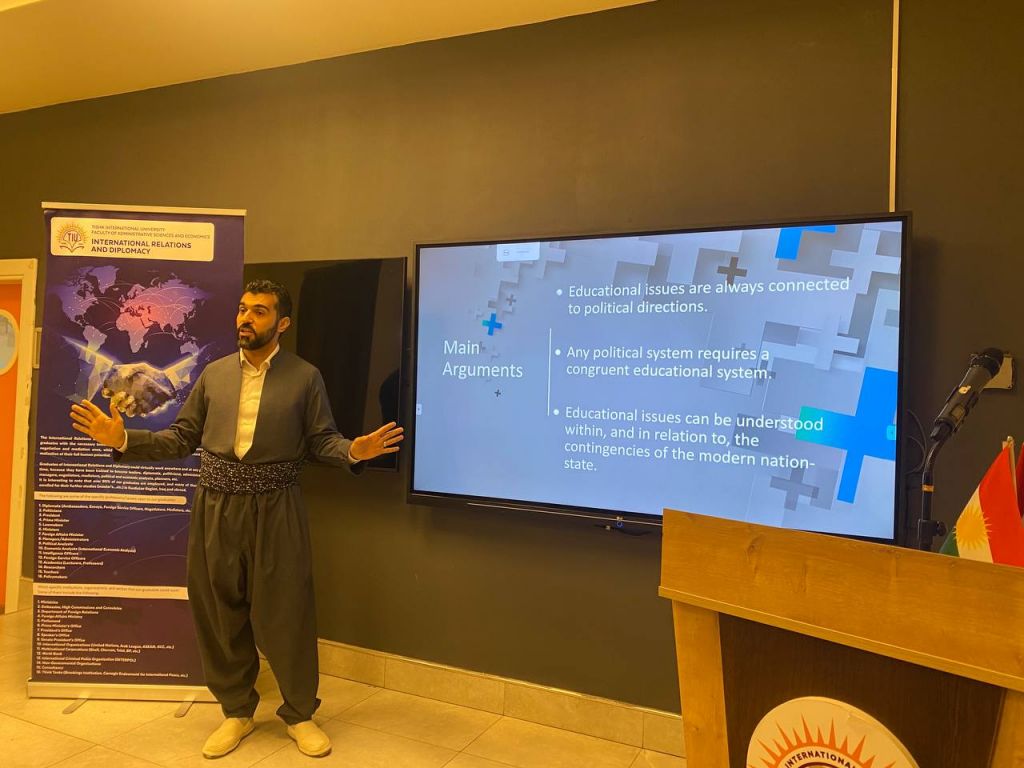
The second distinguished speaker, Dr. Abdurrahman Ahmad, spoke on the topic, Education in the Courtyard of Politics, where he took the participants through the emergence of control over education by governments in the 19th century, following the establishment of the modern state system and bureaucracy through the forces of nationalism, liberalism and industrialism. He explained that the modern educational system is a product of state policy, which is reflective of the set goals and objectives of the political elite and state institutions and agencies, as everything is designed in a structured and universal manner. This, therefore, underscores the influence of politics on education.
Further to the preceding, Dr. Abdurrahman Ahmad explained the connection between the forces of nationalism, liberalism, industrialism and nation, State and education. He pointed out the influence of technology on the education that is imparted to students today. He explained the KRG educational policy and how politics influences the mode of education that is currently being imparted or delivered.
The following recommendations were given by both speakers:
- The public should be enlightened that politics is a noble venture, not a dirty game.
- The best and most patriotic people in the society should participate in politics.
- Political leaders should ensure good governance and promote the Rule of Law.
- Governments at all levels should ensure that the influence of politics on education is positive.
- The KRG educational policy should continuously be improved for the all-rounded development of KRI.
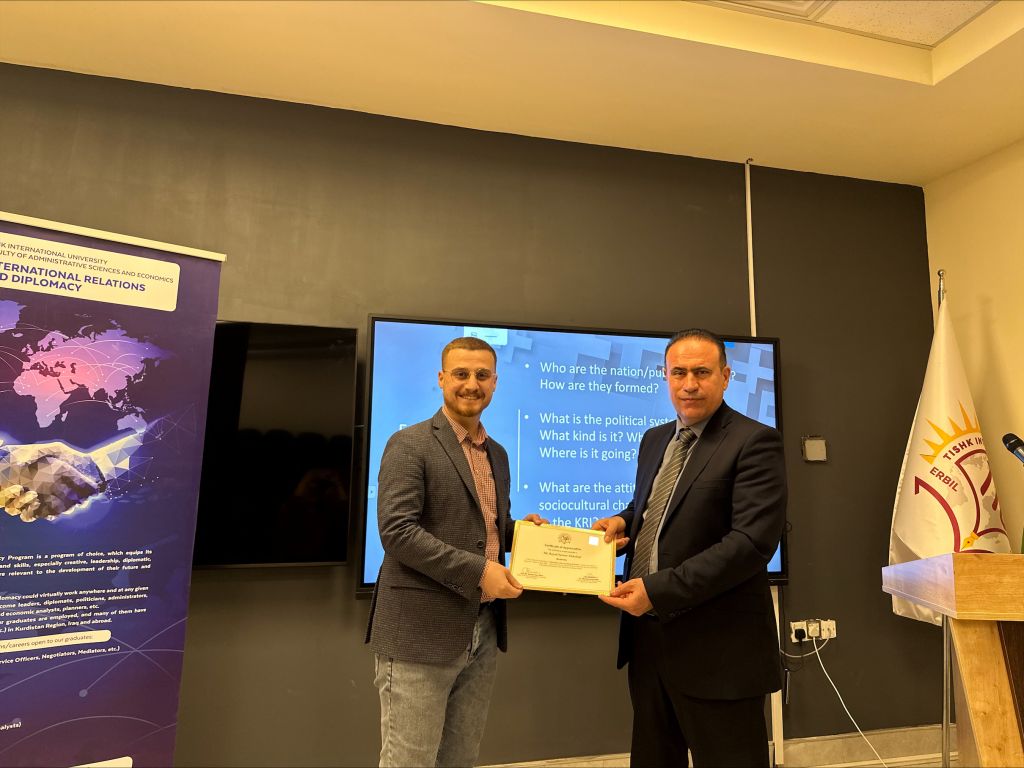
A Q&A session followed, and the speakers responded to all questions and comments that were asked by the participants, which consisted of both TIU academics and students. Finally, certificates of appreciation were given to the speakers and the moderator by the Head of the IRD Department, Dr. Mohammad Salih Mustafa.