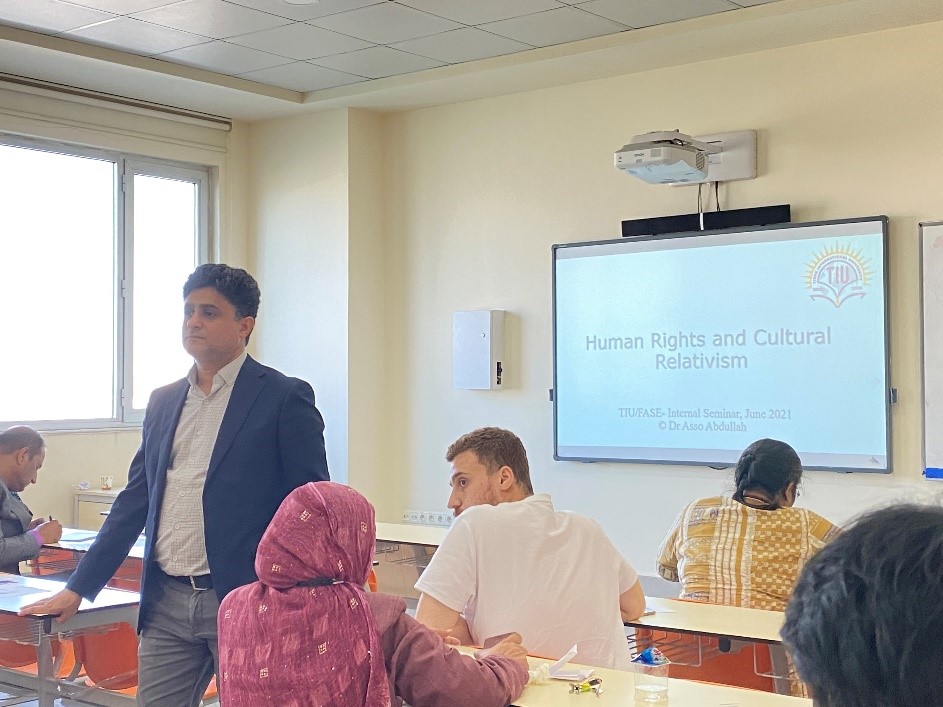

The Faculty of Administrative Sciences and Economics, International Relations & Diplomacy Department organized a workshop on “Human Rights and Cultural Relativism“. The workshop was presented by Dr. Asso Abdulla, lecturer of international relations.
In this presentation, Dr. Asso Abdulla explained how the importance of the choice of the topic is justified by its interdisciplinary character; the first part of the seminar was devoted to clarifying the main concepts of the two main concepts.
Regarding cultural relativism, after recalling its conceptual origin in different academic disciplines (anthropology, sociology, law, IR, philosophy), it has been defined as the rejection of any unique moral system of reference as different societies have different moral codes. The concept of human rights for its part implies rights that are universal and inherent to human beings. In the second part of the seminar, the relationship between the two concepts is explained, both in terms of mutual enrichment (cultural egalitarianism serves human rights’ objective which is equality and non-discrimination) and clash (especially from the point of the view of tensions between the western naturalistic/liberal view to human rights and the anthropological approach to human rights).
Although universalism is accused of being the other face of ethnocentrism and even eurocentrism, accepting cultural relativism would mean tolerance to practices that are in flagrant contradiction with basic human rights (many examples of such a contrast are given in the presentation).
The third and last part of the seminar was aimed at seeking to realize the difficult reconciliation between the two concepts by insisting on the revolving character of the matter, the emergence of common and cross-cultural codes of behavior, and the certainty of a minimum core of human rights to protect. Referring to the position of some international bodies for the protection of human rights, the conclusion of the seminar suggests a solution that helps to find the realistic middle ground that takes into account cultural diversity without any degree of tolerance toward undebatable cases of human rights abuse.